ESSAY
Why Is the Picture Not in the Box?
A five-year-old runs over to see the photographs. The camera has no screen. The pictures are still inside the box. Patricia von Ah on the space between taking a photograph and seeing it.
Patricia von Ah
Founder, SEETHINK Lab & Zero Baseline of Photography
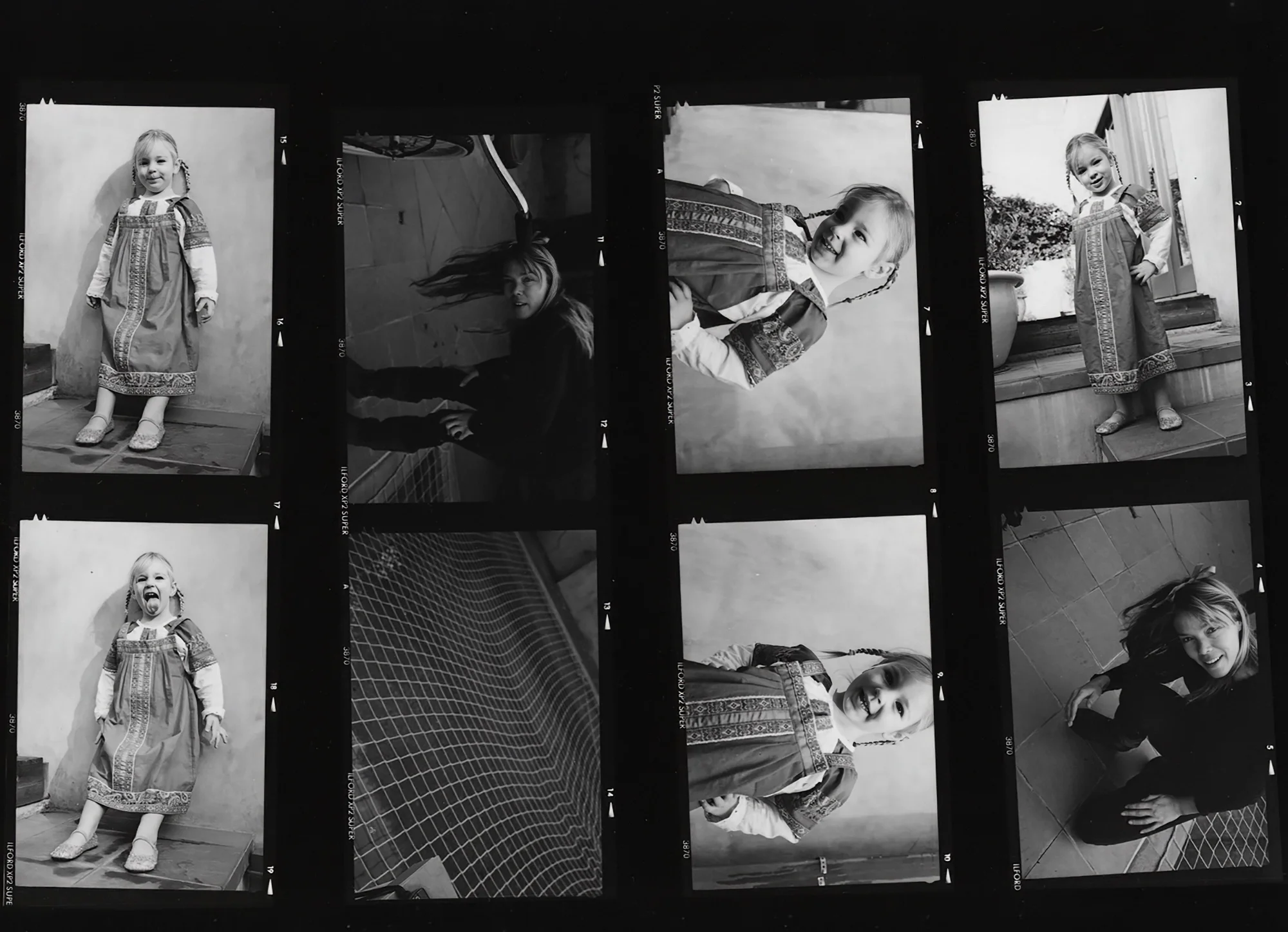
Contact sheet, Ilford XP2. Patricia von Ah. Personal archive.
Show me the pictures
I was photographing my niece. She was five years old, wearing the embroidered dress she had chosen herself, and she was performing for the camera with the full commitment of someone who understood that something important was happening. She posed. At one point I let her try. I showed her how to hold the camera and where to press the button. She pointed it at me and pressed.
Then she looked at the back of the camera, slightly puzzled, as if searching for something. Show me the pictures.
The camera had no screen. It was a film camera, loaded with Ilford XP2. The pictures were inside the box, encoded on a strip of silver halide that had been changed by light but was not yet visible to anyone. I told her the pictures were still in the box. She could not see them yet. They had to be developed first.
She did not accept this. She continued to insist. Show me the pictures.
For her, a camera was a device that showed you what it captured, immediately. Capture and display were the same event. There was no concept of a latent image, no concept of waiting. Her expectation was not unreasonable. It was logical. Based on every camera she had ever seen, the pictures should already be visible.
What the box held
The photograph exists before we can see it. The light that enters the lens during those few minutes alters the chemistry of the film. Each frame holds an image in a state of potentiality: real, but invisible. This is the latent image. It is a photograph that has been taken but has not yet become a photograph anyone can see.
In the darkroom, this changes. The exposed contact sheet enters the developer tray and the image materialises slowly under the red safelight, surfacing from what was, a moment ago, a blank white sheet. You watch it happen. After many years and many photographs, it is still a moment of magic. You know what you photographed. You do not quite know what the photograph will look like until it appears.
In 1943, a three-year-old girl asked her father the same question my niece asked me. Why can I not see the picture you just took? Her father was Edwin Land. He did not dismiss the question. He spent years solving it. The Polaroid was his answer: a camera that carried out the developing process internally and delivered a print within a minute.
Nearly eighty years later, my niece did not expect to watch an image develop. She expected to see it already there, on a screen, fully formed. Land’s daughter had to wait a minute. My niece expected to wait zero seconds.
The contact sheet
When the film came back, I showed her the contact sheet. Every frame from the roll, printed at actual size on a single sheet of paper. Nothing selected, nothing enlarged, nothing edited. The complete record of what happened between us that afternoon.
We sat together and looked at it. She noticed the pattern on her dress. Her own expressions. The photographs she had taken, when she turned the camera around and pointed it at me. She remembered looking through the viewfinder. She remembered pressing the shutter. But she had not seen the results until now, days later. The gap between pressing the button and seeing the results changed what she observed.
The contact sheet does something that the display on a phone does not. It shows everything at once. You see the sequence, the small adjustments, the frame before and after the one that matters. You compare. You notice patterns. You sit with the whole, not one image at a time. At Magnum Photos, photographers were judged not by their final prints but by their contact sheets, because the sheet reveals how a photographer thinks.
For my niece, the contact sheet gave her time. She was reviewing it days later, from the outside, at her own pace. She noticed more because she had to wait. The research I would later pursue through SEETHINK Lab confirmed what that afternoon already showed me: that time changes what is perceived.
Why is the picture not in the box?
For my niece, a photograph is something you see on a screen, immediately after pressing a button. For me, it is something that begins in a box, travels through time, and arrives days later on a sheet of paper.
The picture is in the box. It has always been in the box.
The space between capture and seeing is not empty. It is where the photographer’s memory works on the image before it is seen. It is where expectation separates from reality. It is where the photograph stops being an extension of the moment and becomes something you encounter freshly, as if seeing it for the first time.
Patricia von Ah – Founder, SEETHINK Lab
References:
Edwin Land and the invention of instant photography: Smithsonian
Magnum photographers and their contact sheets: Magnum Photos
Resources:
Visit Zero Baseline of Photography
Image credit: Contact sheet, Ilford XP2. Patricia von Ah. Personal archive
© 2026 Patricia von Ah – SEETHINK Lab. All rights reserved.