ESSAY
The Device in My Pocket
In 1900, twelve men held up a camera the size of a small room to take a single photograph. Today, the device in your pocket does it in a fraction of a second. Patricia von Ah on what changed when the effort disappeared.
Patricia von Ah
Founder, SEETHINK Lab & Zero Baseline of Photography
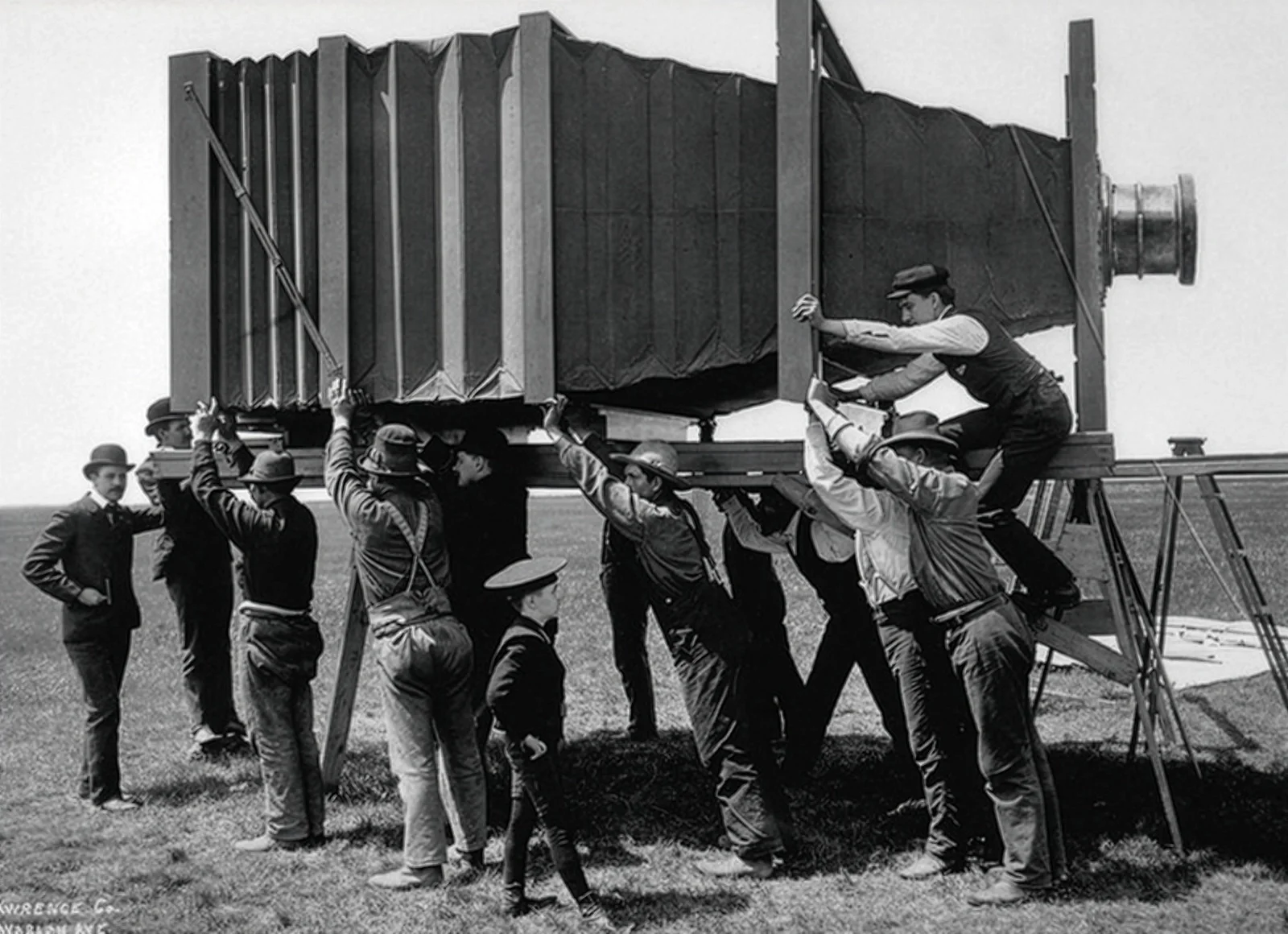
The Mammoth Camera, 1900. Library of Congress, Author: George R. Lawrence Company, Title: The Mammoth Camera, Archive: Library of Congress, Panoramic Photographs Collection, Date: 1900, Rights: Public domain via Wikimedia Commons.
Twelve men and a single photograph
In 1900, it took twelve men to take a photograph of a train. The camera weighed 1,400 pounds. It was built from cherry wood with the the largest Zeiss-design lenses Bausch & Lomb had ever made. A person could step inside it to dust the glass plate before exposure. The exposure lasted two and a half minutes. All of this: the men, the wood, the glass, the chemistry, the waiting, for a single photograph.
The men operating the Mammoth Camera are holding it up. Their hands, their shoulders, their bodies are part of the apparatus. They are physically supporting the act of seeing.
The device in my pocket weighs 252 grams. It takes a photograph in a fraction of a second. It requires one person and a finger.
What effort carried with it
Photography did not begin as something easy. In 1827, Niépce needed eight hours of sunlight to capture a single view from his window. Twelve years later, Daguerre brought that time down to minutes, but each image was still unique, still fragile, still the result of precise chemical knowledge and physical labour. When Kodak introduced the Brownie for one dollar, the act opened to the public for the first time. But every press of the shutter still required patience: the roll had to be sent away, the prints returned days or weeks later.
Each of these constraints did something that we rarely consider. They imposed selection. When every exposure counts, you choose what to photograph. When the result is invisible until the prints come back, you hold the moment in your mind. When the camera requires setup and stillness, you prepare yourself for the act. The effort was a form of attention.
Labour imposed selection. Duration imposed presence. Weight imposed intention. And the three, together, shaped how a person chose to capture.
The difference matters because it tells us something about what seeing asks of us when the constraints fall away.
The Polaroid, in 1948, removed the wait. You watched the image appear in your hands. But it was still physical: paper, chemistry, one picture at a time, and each one cost something. The first digital camera prototype in 1975 recorded a single black-and-white image in twenty-three seconds to a cassette tape. By 1999, the first phone camera had arrived. By 2007, photography had become a default capability of the device everyone carries.
In 2026, roughly five billion photographs are taken every day. Today more images are produced in a single week than in the entire first century of photography.
The observer and the device
The smartphone has given photography to everyone, everywhere, at every moment. It has made the medium democratic in ways that Niépce, Daguerre, and even Kodak could not have imagined. Families document their lives. Witnesses record what they see. Artists work with a tool that fits in one hand.
Something changed in the transaction between the person and the image. When capture becomes reflexive, the relationship between seeing and thinking shifts. Not because the thinking stops. It shifts because the moment of reflection changed. It used to sit before the shutter: in the choosing, the framing, the deciding whether this was worth an exposure. Now it sits after, if it sits anywhere at all.
Today, the average attention given to a single piece of visual content has been measured at around seven seconds. The device enables us to capture at an overwhelmingly fast pace. Seeing requires the willingness to stay with an image, to let it work on you, to notice what the surface holds that your first glance might have passed over.
Digital Natives have never known a world without the device. They navigate a landscape of images more vast and more saturated than anything before. They do remarkable things with the medium. The question is whether the practice of seeing will travel with them, or whether it will be lost and need to be found again.
The device in my pocket
I carry the device. I use it every day. I know what it can do and I am grateful for it. But I also know what came before. I know what it feels like to hold a camera that requires something of me before it gives anything back. I know what it means to wait for a photograph, to hold the image in my mind before it exists.
The device gives everyone the ability to capture an image. It does not give everyone the time to see. That has to be chosen.
Patricia von Ah – Founder, SEETHINK Lab
References:
Resources:
Visit Zero Baseline of Photography
Image credit: Library of Congress, Author: George R. Lawrence Company, Title: The Mammoth Camera, Archive: Library of Congress, Panoramic Photographs Collection, Date: 1900, Rights: Public domain via Wikimedia Commons.
© 2026 Patricia von Ah – SEETHINK Lab. All rights reserved.