ESSAY
As If for the First Time
In 1879, a mathematician asked his audience to forget everything they knew and observe the world as if they had never seen it before. Patricia von Ah on the invitation that became the foundation of SEETHINK Lab.
Patricia von Ah
Founder, SEETHINK Lab & Zero Baseline of Photography
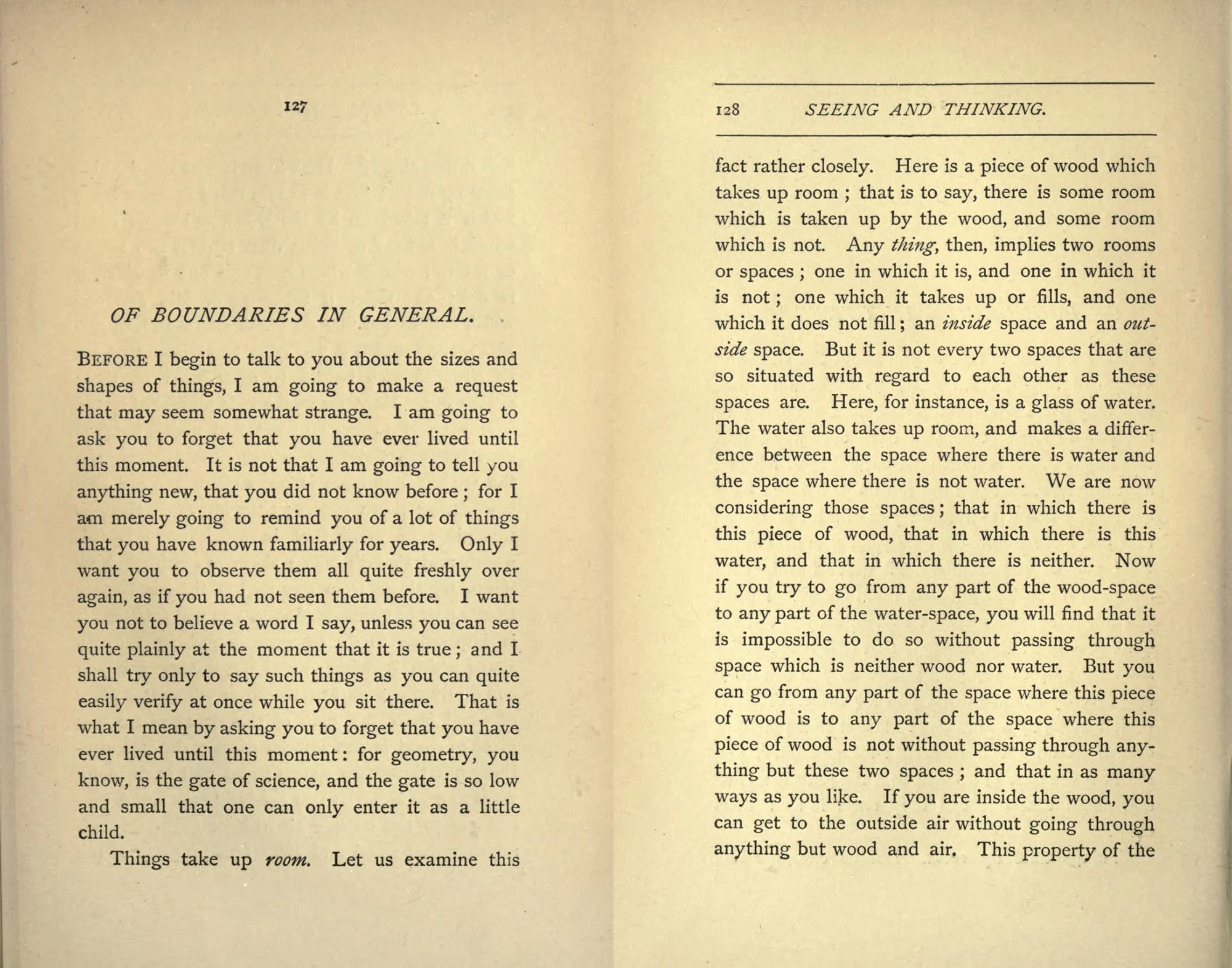
Page 127, Seeing and Thinking (1879). W. K. Clifford. Macmillan, London. 1890 edition.
A small book of lectures
In 1879, a mathematician stood in a town hall in Shoreditch and asked his audience to do something unusual. He did not ask them to learn. He asked them to forget.
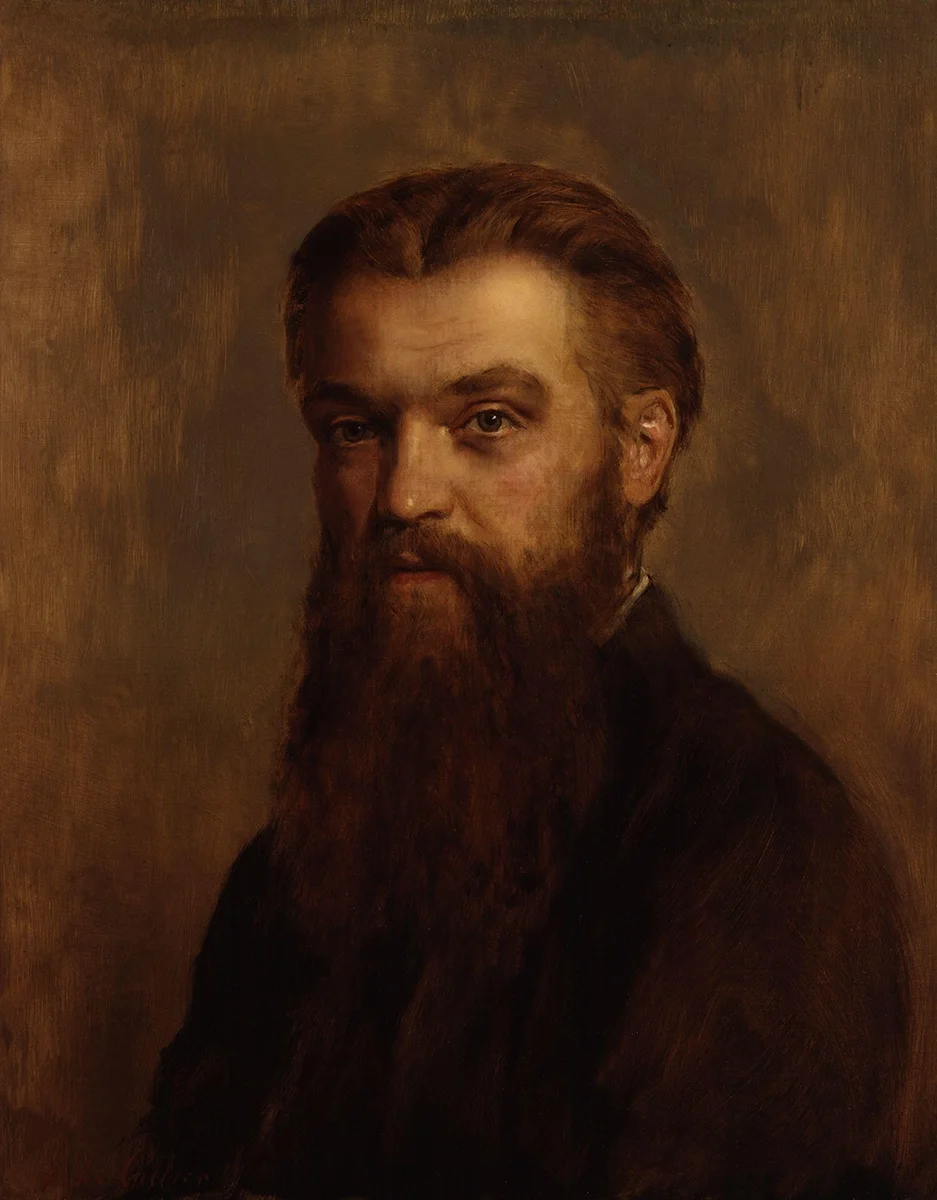
William Kingdon Clifford was thirty-three years old. He held the chair of applied mathematics at University College London. He had been elected to the Royal Society at twenty-nine. His work on the geometry of curved spaces would anticipate Einstein’s general theory of relativity by nearly four decades. He also wrote fairy tales for children.
The lectures he gave that year became a book called Seeing and Thinking. It was published by Macmillan in their Nature Series, written not for academics but for anyone willing to pay attention. It was among the last things he wrote. He died of tuberculosis the same year.
On page 127, at the opening of his final chapter, Clifford made the invitation:
“Forget that you have ever lived until this moment. It is not that I am going to tell you anything new, that you did not know before; for I am merely going to remind you of a lot of things that you have known familiarly for years. Only I want you to observe them all quite freshly over again, as if you had not seen them before.”
He was about to talk about geometry. Boundaries, surfaces, the inside and outside of things, the eye and the camera. But the invitation reaches further than any single subject. It is a method. And it begins with a subtraction.
What forgetting makes possible
The instruction is deceptively simple. Forget what you know. Observe as if encountering things for the first time. But forgetting what you know is not a passive act. It takes effort to set aside the labels you carry for the things you see every day. The glass on the table is not a glass. It is a transparent object containing liquid. The liquid meets the glass at a boundary. The boundary has a shape. The shape changes when you tilt it.
Clifford used objects like these in his lectures. Wood, water, a glass with a spoon in it. He asked his audience to look at them as if they had no names. He moved from the visible surface to the geometry underneath: what is inside and what is outside, where one substance ends and another begins, what happens at the boundary between them. These are questions about perception disguised as questions about geometry.
What he was doing, without calling it that, was phenomenology: bracket your assumptions, attend to the thing itself, describe what remains. Husserl would formalise that method two decades later. Clifford got there through mathematics and a willingness to take a general audience seriously.
He also added a second instruction, less often quoted:
“I want you not to believe a word I say, unless you can see quite plainly at the moment that it is true.”
This is not a request for trust. It is a request for verification. See for yourself. If you cannot confirm it with your own eyes, do not accept it. The same man who argued, in his most famous essay, that it is wrong to believe anything upon insufficient evidence now applied that principle to the act of seeing. The invitation to see freshly is not soft. It is rigorous. It asks you to trade familiarity for attention.
Between the seeing and the thinking
Elsewhere in the book, Clifford reaches for an analogy. The eye, he writes, is merely a camera made of glass with a sensitive plate instead of a retina. He was writing forty years after Daguerre's announcement of the daguerreotype. Photography was still new enough to be remarkable. The fact that a mathematician reached for the camera to explain the eye tells us something about how central the photographic lens already was to understanding vision. It also tells us something about Clifford. He moved between disciplines the way other people move between rooms.
I found the book during my research. A small book of lectures, modest in size. But what I read there changed the direction of everything that followed. Clifford’s invitation to see and think as separate but entangled acts landed on something I had been circling without being able to name: between the seeing and the thinking, there is an experience. Not seeing alone. Not thinking alone. Something that exists in the space between the two. That recognition is where the inquiry begins.
SEETHINK Lab takes its name from Clifford’s title. The exercises developed are practical enactments based on his invitation. The Experience Enhancer removes distraction so that the eye can attend to what is actually in front of it. The Pixel to Image exercise abstracts an image back to its most basic units, forcing the viewer to ponder what they see rather than recognise it. The One Minute Exposure allows sustained attention on a single image. Each one asks the same thing Clifford asked in Shoreditch: don’t assume you already know what you are looking at. Observe it again. Freshly.
As if for the first time
Clifford died at thirty-three. His work in mathematics anticipated the curvature of spacetime by decades. His philosophical writing anticipated phenomenological inquiry before the term existed. He wrote fairy tales for children and lectured on geometry in town halls. Seeing and Thinking was published the year he died. It is a small book. It fits in one hand.
Nearly 150 years later, the invitation still holds because it is honest and because it costs nothing to try. See for yourself. Do not take someone else’s word for it. Attend to the thing in front of you as if you have never seen it before.
The world is full of things we think we already understand. Clifford’s question is whether we have actually looked at them. The difference between is the space where experience begins.
Patricia von Ah – Founder, SEETHINK Lab
References:
W. K. Clifford, “Seeing and Thinking” (1879, Macmillan): full text at Internet Archive
Maria Popova on Clifford’s “Ethics of Belief”: The Marginalian
Ned Block, “The Border Between Seeing and Thinking” (2023, Oxford): the contemporary question Clifford opened
Resources:
Visit Zero Baseline of Photography
Image credits: Page 127, “Of Boundaries in General,” from Seeing and Thinking by W. K. Clifford. Macmillan, London, 1890 edition. National Portrait Gallery, Public domain, via Wikimedia Commons, Author: John Collier, Title: William Kingdon Clifford, Date: 1878, Medium: Oil on canvas, Rights: Public domain.
© 2026 Patricia von Ah – SEETHINK Lab. All rights reserved.